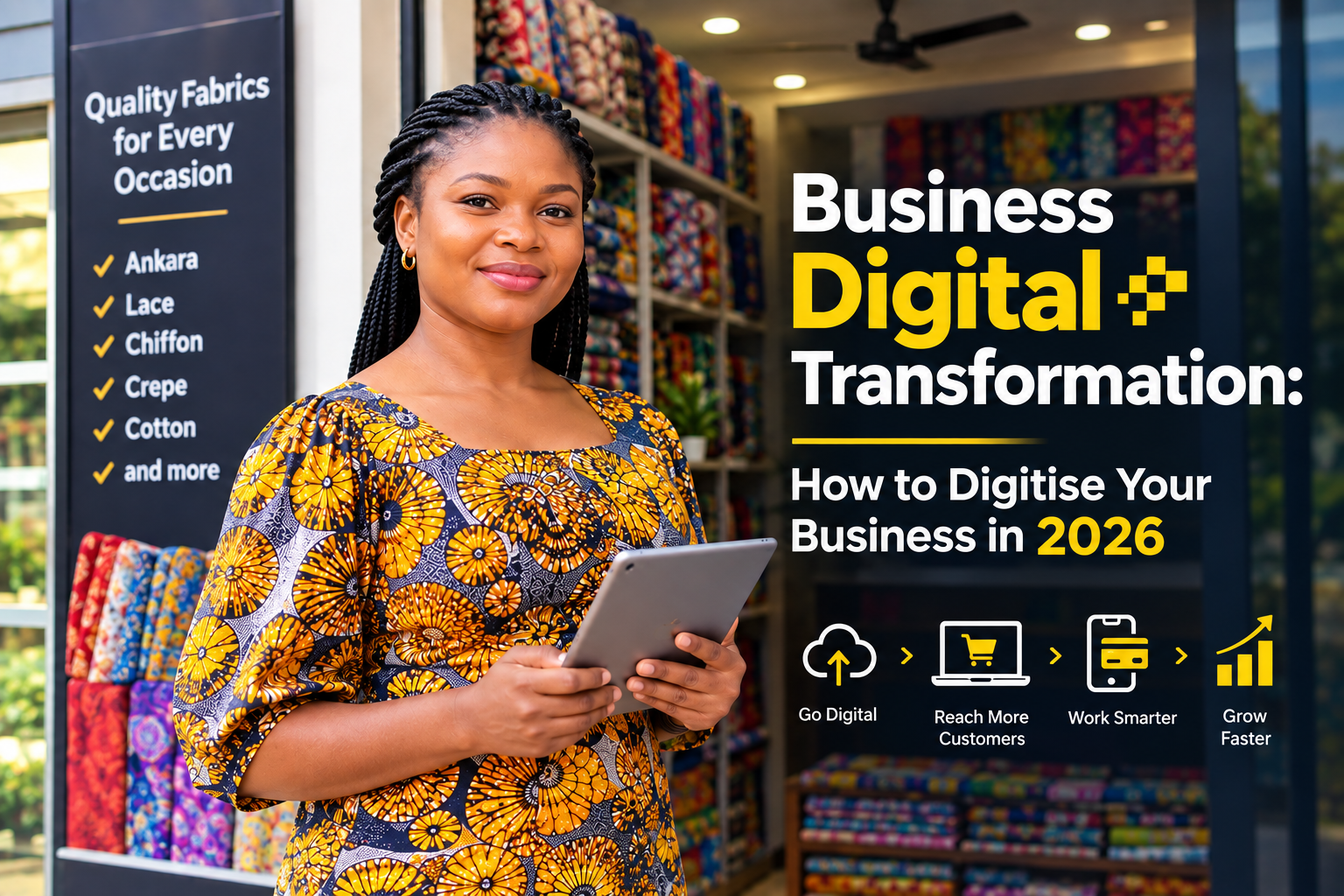
Running a business with notebooks, spreadsheets, paper files, WhatsApp messages, and scattered documents may work when the business is small. But as your business grows, managing everything manually can become slow, stressful, and prone to errors.
This is where business digital transformation comes in.
Digital transformation is not simply about buying computers or creating a website. It is about using technology to improve how your business operates, serves customers, manages information, and makes decisions.
What Is Business Digital Transformation?
Business digital transformation is the process of using digital technology to improve business processes and operations.
Instead of relying entirely on manual processes, a business can use tools such as:
Business management software
Websites and mobile applications
Cloud storage
Customer relationship management (CRM) systems
Inventory management systems
Digital payment solutions
Data analytics
Artificial intelligence (AI)
Workflow automation
The goal is simple: use technology to make the business more efficient, organised, and scalable.
Why Should Businesses Move Away From Manual Processes?
Manual processes are not necessarily bad. In fact, many businesses start with them.
The problem comes when the business grows but the systems do not grow with it.
For example, imagine a business recording inventory in a notebook. Every time a product is sold, someone has to update the record manually.
Now imagine the business has hundreds of products, multiple employees, and several sales channels.
A simple inventory management system could automatically record sales, update stock levels, generate reports, and help the business identify products that need to be restocked.
That is digital transformation in practice.
5 Areas of Your Business You Can Digitise
1. Customer Management
Instead of keeping customer information across notebooks, phones and WhatsApp conversations, businesses can use a CRM system to organise customer information and interactions.
This makes it easier to follow up with customers and maintain better relationships.
2. Inventory Management
Businesses that sell physical products can use digital inventory systems to track:
Products in stock
Products sold
Low-stock items
Purchases
Sales
Inventory reports
This can significantly reduce the risk of losing track of stock.
3. Finance and Records
Digital systems can help businesses organise invoices, expenses, payments and financial records.
They can also make it easier to generate reports and understand how the business is performing.
4. Employee Management
Technology can also simplify employee attendance, task management, communication and documentation.
Instead of depending entirely on paper records, businesses can centralise important information and workflows.
5. Sales and Customer Experience
A website, e-commerce platform or mobile application can make it easier for customers to discover products, make enquiries and complete purchases.
Businesses can also connect their digital platforms with payment systems and other tools to create a smoother customer journey.
Does Digital Transformation Mean You Need Expensive Technology?
Not necessarily.
One of the biggest mistakes businesses make is trying to digitise everything at once.
A better approach is to identify the biggest problem first.
Ask:
What takes the most time?
Where do we make the most mistakes?
What information is difficult to find?
Which process frustrates our employees or customers the most?
Start there.
A business might need a simple website. Another might need an inventory management system. Another might benefit most from automating customer follow-ups.
The right digital solution depends on the business.
Start Small, Then Scale
Digital transformation does not have to happen overnight.
You can begin by replacing one manual process with a digital solution, measure the improvement, and then move to the next.
Over time, these improvements can create a more organised and efficient business.
The goal isn't to use technology simply because it is available.
The goal is to use the right technology to solve the right business problem.
Ready to Digitise Your Business?
At I-Swipe Tech, we help businesses identify opportunities to use technology more effectively. From websites and mobile applications to custom business solutions, data and digital services.
If your business is still relying heavily on manual processes, this may be the right time to start your digital transformation journey.
Your business can grow. Your systems should be ready to grow with it.
Ready to Build a Tech Career?
Join thousands of students learning in-demand digital skills at I-Swipe Academy. Real projects, expert mentors, 12 weeks.
🚀 Apply Now →